
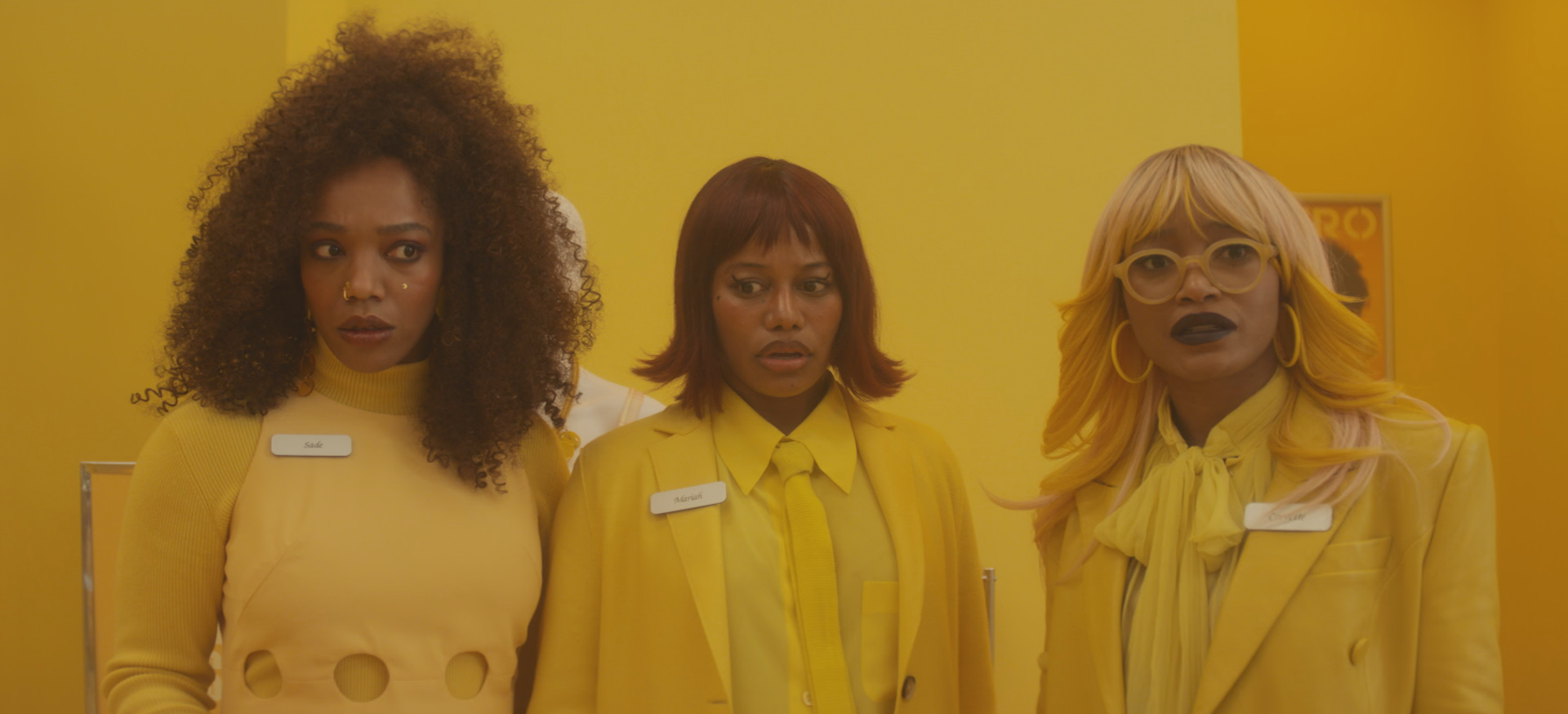
There is a moment in the latter half of I Love Boosters where the film shifts into something that critics have struggled to fully put into words. The images take on a quality that feels different from everything else on screen — tactile, slightly unreal, built rather than rendered. Audiences at the film’s world premiere at SXSW in March felt it immediately. Reviewers came out of the Paramount Theatre talking about the miniature work the way people once talked about the practical effects in the films that defined the craft decades ago. That is not a coincidence. That is Christopher Lee Warren and his team at Blind Beagle VFX.
Christopher has spent his entire career working in the space where camera, light, and scale collide. His father Gene Warren Jr. co-founded Fantasy II Film Effects in the early 1980s and won the Academy Award for Terminator 2: Judgment Day in 1992 — a film Christopher worked on as camera operator. His grandfather Gene Warren Sr. won the Oscar for The Time Machine back in 1960. The Warren family understanding of what miniatures can do — and more specifically, what they can make an audience feel — runs deeper than any technical credit could communicate.
Christopher’s own career as a director of miniature photography spans three decades and some of Hollywood’s most demanding productions. The Abyss. Strange Days. Scream 3. Hellboy. Underworld and its sequel. Constantine. Moonrise Kingdom. The Terminator franchise across multiple generations. The Titanic specials for James Cameron in 2017 and 2023. And most recently, Megalopolis — Francis Ford Coppola’s long-gestating epic, where Christopher served as miniature Director of Photography alongside a Coppola family relationship that stretches back through Bram Stoker’s Dracula and beyond.
Each of those productions demanded something different. Each required Christopher to understand not just how to photograph a miniature, but how to make a director’s vision feel true at a scale the camera could capture and an audience would believe. That is the skill. Not building the model — making the audience forget it is one.
Boots Riley came to I Love Boosters with an explicit mandate: do it in camera. Big, bold, practical. No digital slickness. No rendering farm standing in for craft. Riley wanted a world that felt handmade, and he wanted lenses that had personality — which is why cinematographer Natasha Braier spent weeks at Panavision developing a completely custom anamorphic set that borrowed from vintage glass and deliberately embraced optical imperfection. The entire production was oriented around the idea that the best images are the ones that carry the trace of human hands.
That is exactly the environment Christopher has operated in his entire career. And the results show. What began as a more modest application of miniatures in the film expanded significantly once the team understood what the format was giving them. The more they built, the more the film became itself.
Christopher was present at SXSW 2026 as a featured Below the Line mentor — at the same festival, in the same week, where audiences were discovering for the first time just how central the practical work is to what makes I Love Boosters work and his second feature DreamQuil also premiering at the festival. Critics called the stop-motion and miniature photography extraordinary. They described it as adding a tactile delirium that digital effects could not have achieved. One reviewer noted that it was the handmade quality that made the film feel like a real artistic object in a landscape dominated by visual sameness.