
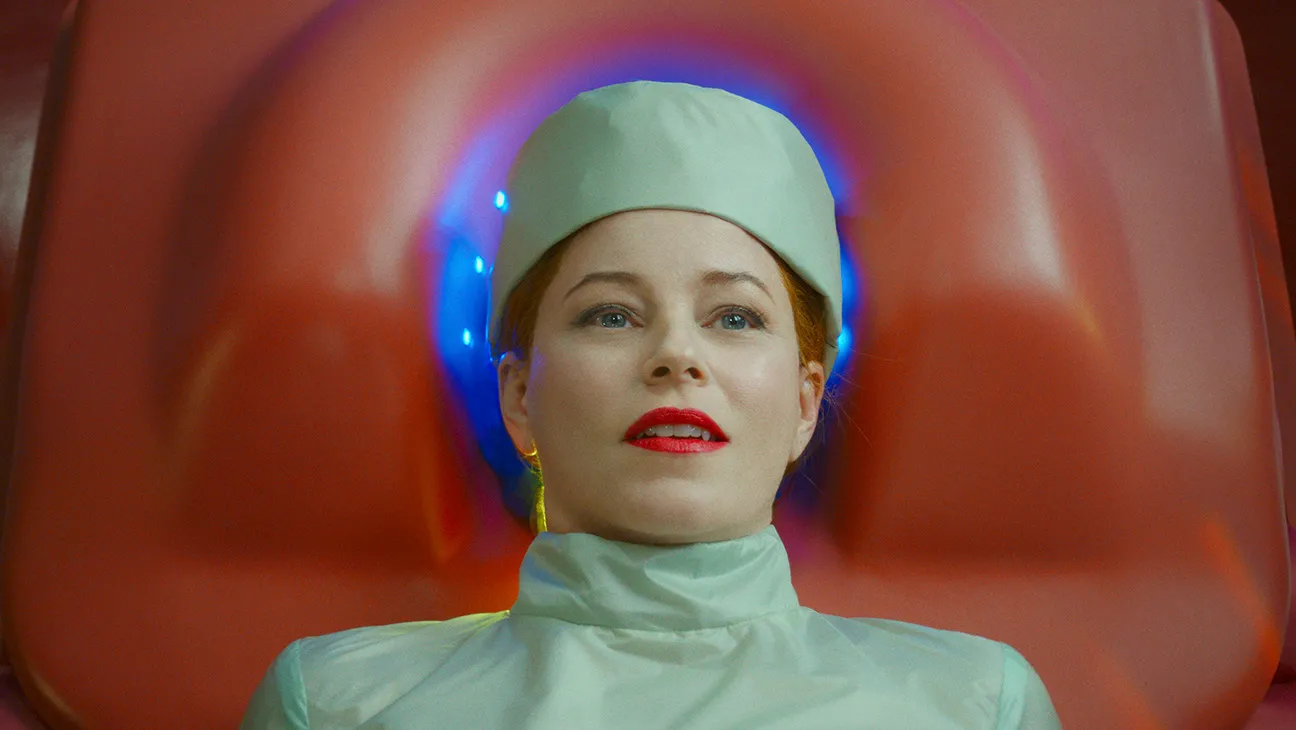
Alex Prager has spent her career building worlds that feel simultaneously real and impossible. As a photographer and visual artist, her images have always had a cinematic quality — hyper-styled, saturated with unease, populated by figures who seem to exist just slightly outside of ordinary time. When she made the move to feature filmmaking with DreamQuil, her 2026 psychological thriller starring Elizabeth Banks and John C. Reilly, she brought with her the same collaborators who had helped her realize that vision in three dimensions just months earlier.
The relationship between Prager and Blind Beagle VFX didn’t begin on a film set. It began at Miami Art Week in December 2025, where Prager unveiled Mirage Factory — a large-scale, walk-through cinematic installation that transformed Miami Beach’s historic 1940 Beach Theatre on Lincoln Road into a series of hyper-detailed miniature environments tracing Los Angeles from its orange-grove origins through Hollywood’s neon era. Blind Beagle VFX served as the Master Miniature Model Makers from conception to fruition on the installation, building the sets that visitors walked through and towered over. The collaboration was an immediate success, celebrated as one of the most immersive highlights of the week.
When DreamQuil went into production, Prager knew exactly who she wanted. Christopher Lee Warren and Gene Warren III are both credited as Miniatures on the film — the brothers alongside the Blind Beagle VFX team working together on a project for a director who already understood, from direct experience, what this family is capable of building.
DreamQuil is set in a near-future world where poor air quality has driven people to live mostly virtual lives. Banks plays Carol, a career mother who signs up for an avant-garde digital wellness retreat called DreamQuil, only to return home and discover her family has been living with a robot double sent in her absence. It is the kind of film that lives or dies on the credibility of its world — and that world, according to critics who covered its SXSW premiere on March 16, 2026, is one of its strongest elements. The miniature work in particular drew consistent praise, with reviewers noting the inventive and aesthetically distinctive way the film’s futuristic technology and wider societal landscape was rendered on screen.
Prager’s background as a visual artist gave DreamQuil a specific sensibility from the start — a commitment to building environments that could be photographed rather than generated. Cinematographer Lol Crawley and production designer Annie Beauchamp brought that world to life around the Banks and Reilly performances, with the miniature work from Christopher and Gene Warren III providing the tactile underpinning that gave the film’s future its texture and scale.
It is also a family story within a family story. Christopher Lee Warren the founder of Blind Beagle VFX is Gene Warren III’s brother and part of the third generation of Warrens working in visual effects. Their grandfather Gene Warren Sr. won the Academy Award for The Time Machine in 1960. Their father Gene Warren Jr. won it for Terminator 2: Judgment Day in 1992. The craft has been passed down not as instruction but as immersion — built into the work itself across decades and productions and now, once again, onto a cinema screen.
DreamQuil premiered at SXSW 2026 and will be released in theaters at a future date.