
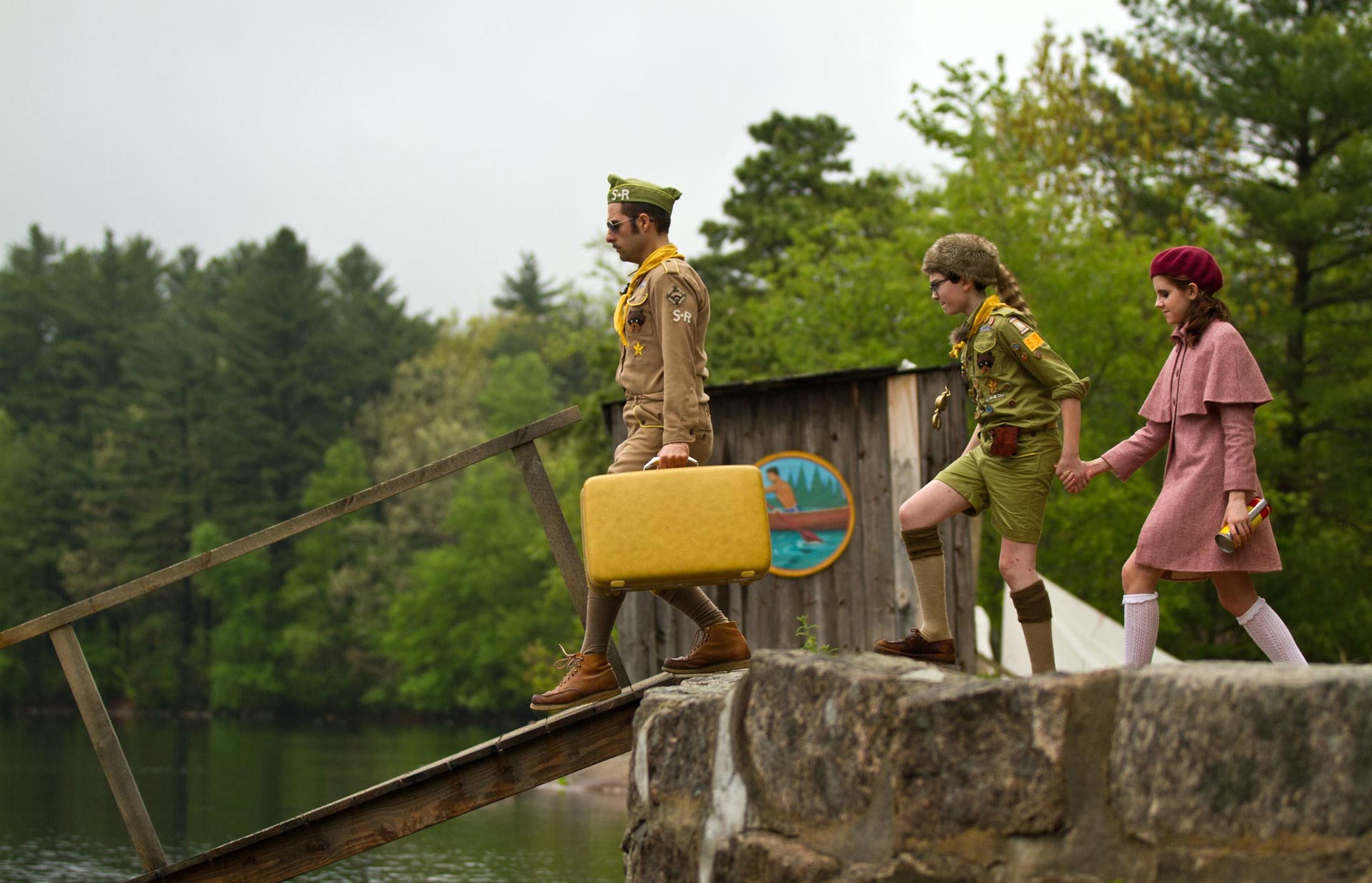
Wes Anderson has always made films that look like they were built rather than shot. His movies have a diorama quality — precise, warm, contained — that critics have reached for metaphors to describe since Rushmore. Roger Ebert wrote about Moonrise Kingdom specifically in those terms, noting that the film begins in what appears to be a toy house with tiny people living inside, and that Anderson’s pictures often look as though they were filmed through a tilt-shift lens, not because they are, but because they feel handmade in every frame. For Moonrise Kingdom, that feeling wasn’t only aesthetic. Part of it was literal.
Fantasy II Film Effects handled the miniature visual effects on the film, with Gene Warren Jr. serving as visual effects supervisor and Christopher Lee Warren as visual effects director of photography. The miniatures supported the film’s climactic storm sequence — the flood that descends on New Penzance Island as Sam and Suzy stand on the church bell tower in the rain — one of the most visually striking sequences in any Anderson film and one that required the kind of practical environment-building that CGI weather rarely convincingly delivers.
The fit between Anderson and Fantasy II was a natural one. Anderson’s entire filmmaking sensibility is oriented around the handmade and the physical. He shoots on film. He builds elaborate sets. He uses practical props and practical costumes and practical everything, wherever possible. When the storm had to come, it came the same way — built, lit, photographed. Christopher has spent his career in exactly that space: understanding how light behaves at miniature scale, how water moves differently when the camera is closer than the eye expects, how to photograph a small thing in a way that makes it feel monumental.
Moonrise Kingdom was released in May 2012, premiered at Cannes, and went on to earn an Academy Award nomination for Best Original Screenplay. It sits at 94% on Rotten Tomatoes and remains one of the most beloved films in Anderson’s catalogue — a movie about two children who build their own world against the one adults have made for them, shot in a way that honors exactly that impulse.
The Warren family has been doing this since before most of the directors they work with were born. Gene Warren Sr. won the Academy Award for The Time Machine in 1960. Gene Warren Jr. won it for Terminator 2: Judgment Day in 1992. Christopher has spent three decades as the eye behind the camera for some of the most demanding practical effects work in the industry. Moonrise Kingdom is one chapter in a story that keeps being written.